

Overview
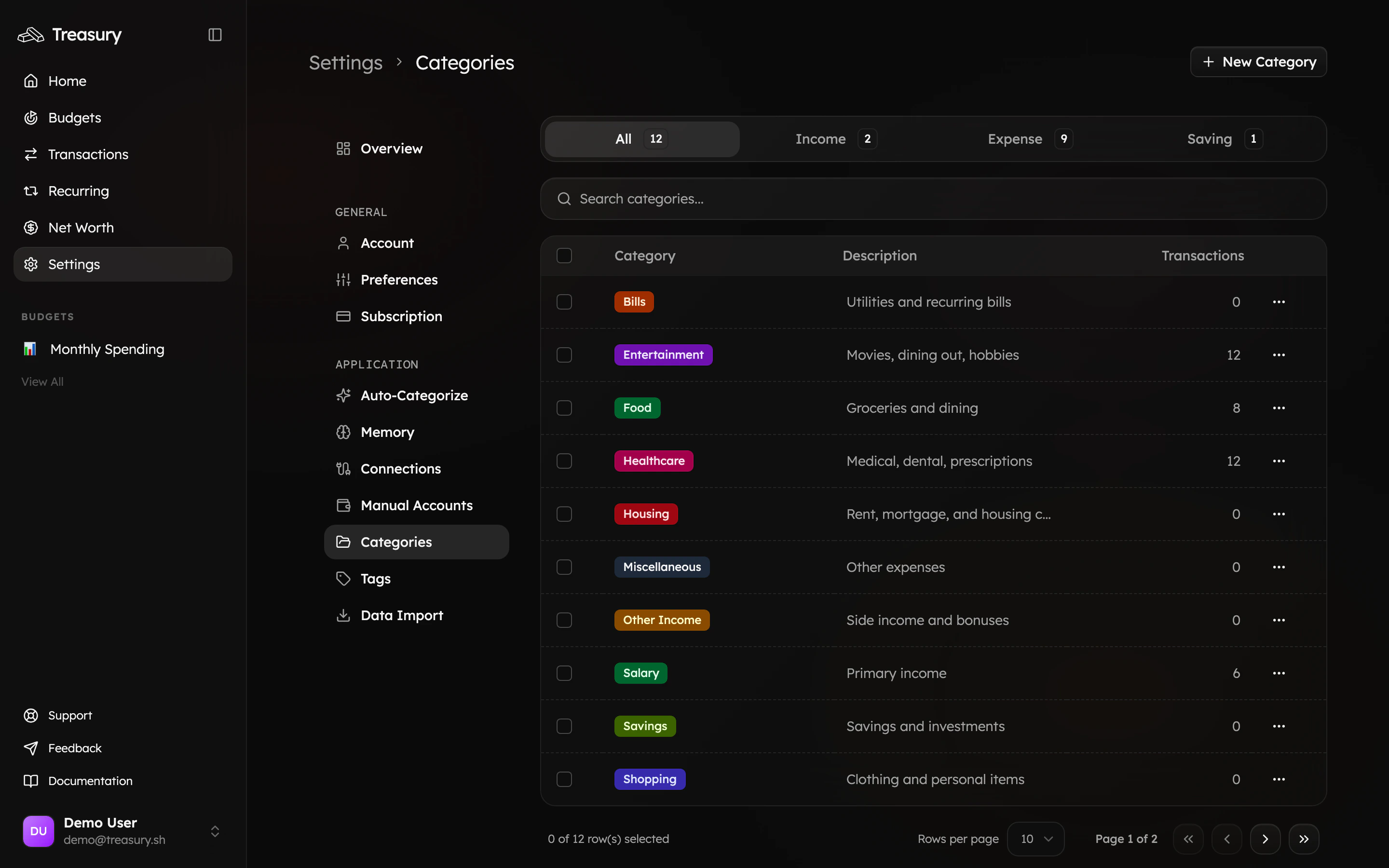
Your categories are found in Settings > Categories. This is where you create and manage the categories that organize your transactions — the foundation every budget and spending insight is built on.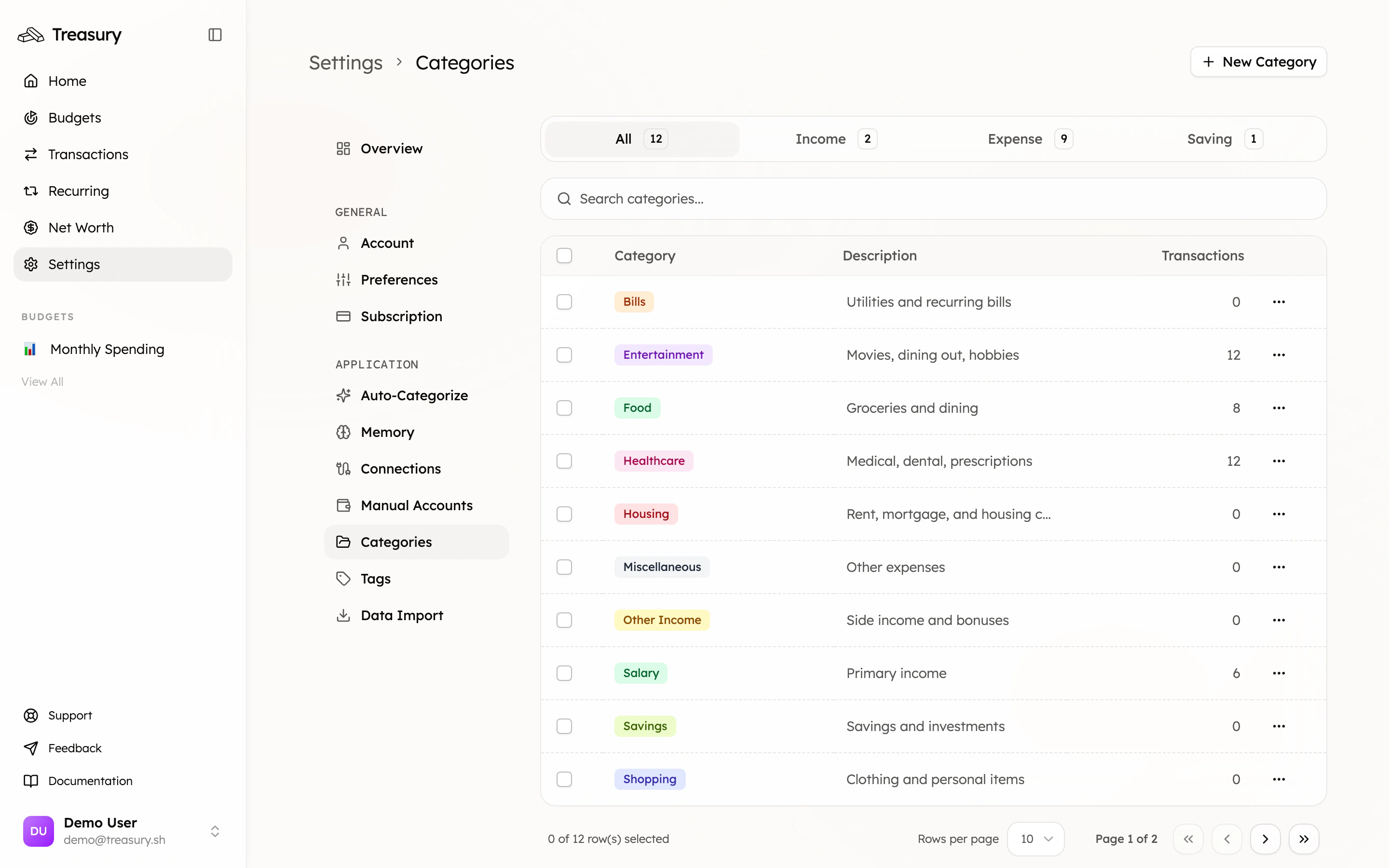
What you can do here
- Create custom categories for income, expenses, and savings.
- Edit a category’s name, type, color, or description.
- Delete a category and reassign or clear its transactions.
- Use the Default preset to start with a well-rounded set.
What are Categories?
Categories help you organize and track your expenses by grouping similar transactions together. You can create custom categories to suit your budgeting needs, making it easier to analyze your spending patterns.Category Types
Treasury offers three category types for organizing budget plans and progress. Changing a category type does not reverse a transaction’s direction or automatically exclude it from cashflow. See what budget Ins and Outs count.Keep your categories broad (e.g., Food, Rent, Salary). For trip or event-specific
tracking, use Tags instead.
Manage Categories
To manage your categories, navigate to the Settings → Categories page. Categories organize your transactions and power your budgets and reports. Use them to group income, expenses, and savings in a way that reflects how you manage your money. Click the table view in the top right corner to see all your categories in a list format — from there, you can create, edit, or delete categories.Create a Category
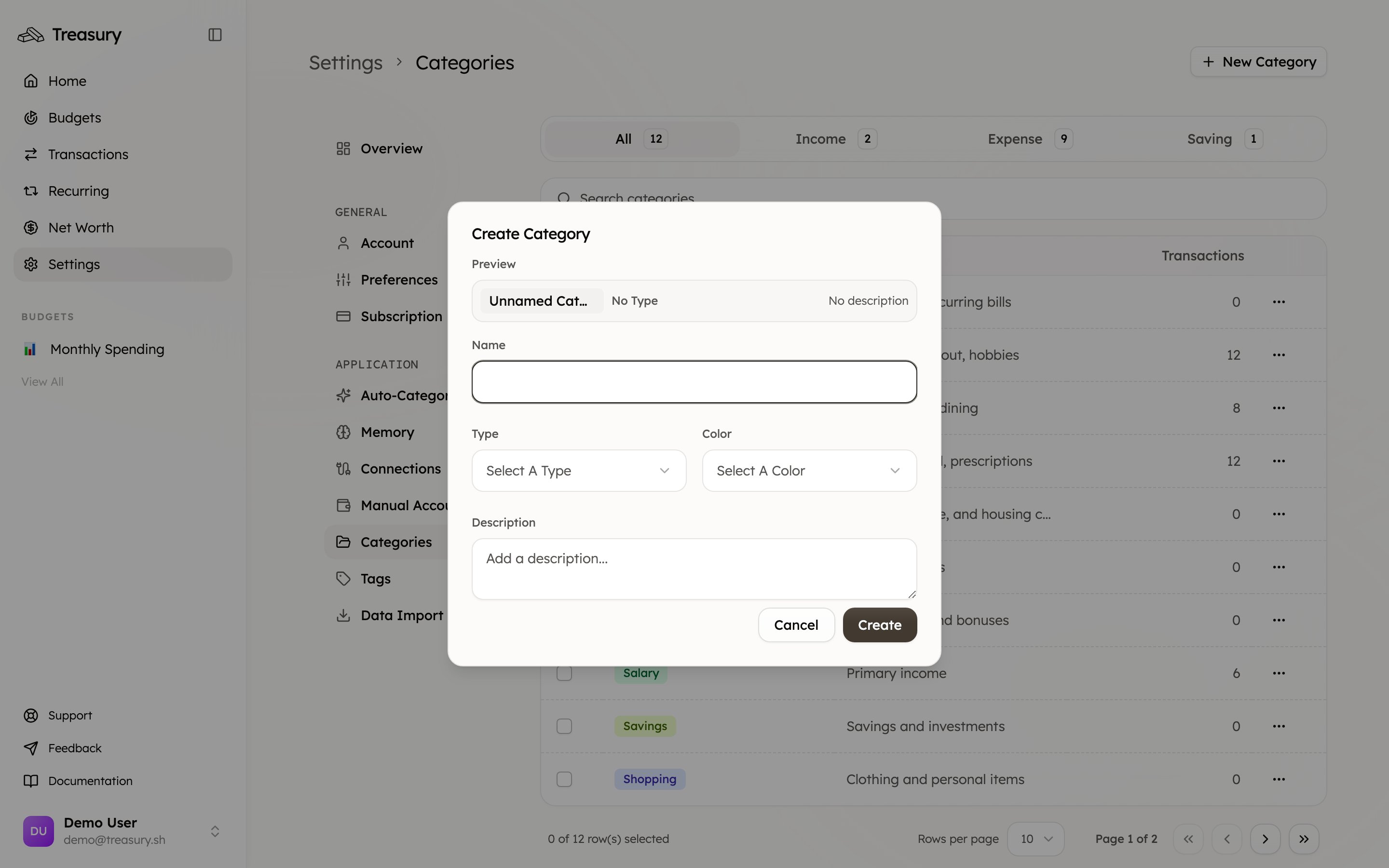
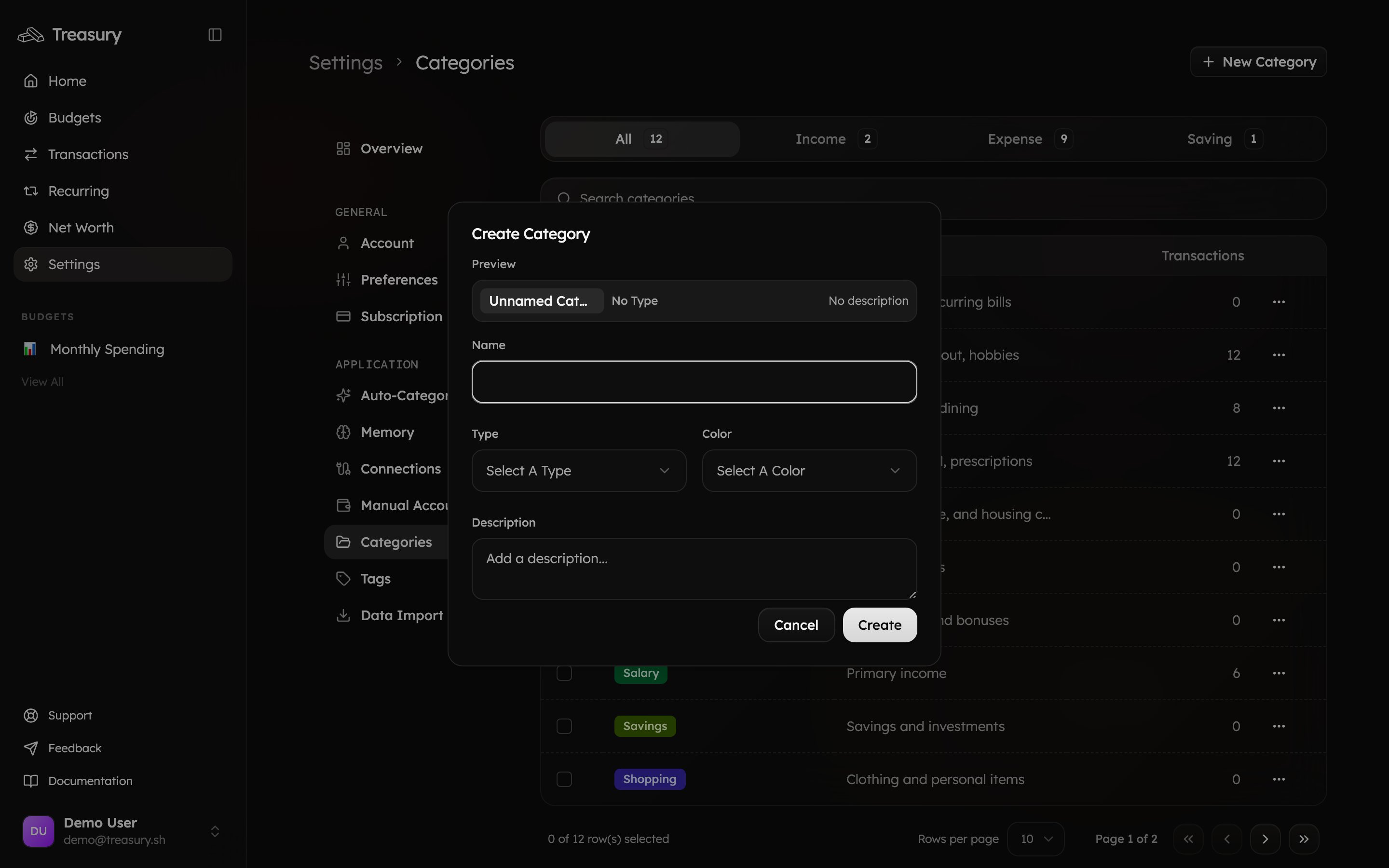
To add a new category:- Go to Settings → Categories.
- Click New Category in the top right corner.
- Enter a Name for your category.
- Select a Type — Income, Expense, or Saving.
- Choose a Color and optionally add a Description.
- Click Create to save.
Edit a Category
To edit an existing category:- Go to Settings → Categories.
- Find the category you want to change.
- Click the three dots (
⋯) and select Edit Category. - Update the Name, Type, Color, or Description.
- Click Save Changes to apply your edits.
Delete a Category
To delete a category:- Go to Settings → Categories.
- Find the category you want to remove.
- Click the three dots (
⋯) and select Delete Category. - A confirmation window will appear showing how many transactions are currently assigned to that category.
- Choose one of the following options:
- Make Uncategorized — remove the category label so you can review and reassign transactions later in Transactions or Turbo Review.
- Reassign to Category — move all transactions to another category (e.g., merging Dining Out into Food).
- Click Delete Category to confirm.
Use Categories in Budgets
Categories are the building blocks of your budgets.When you create a new budget in Treasury, you’ll choose which categories to include and how much money to allocate to each one. For example, if you creates a monthly budget, you might include:
- Food → $600
- Rent → $1,600
- Shopping → $300
FAQ
What's the difference between a category and a tag?
What's the difference between a category and a tag?
A category is the type of spending (Food, Rent, Salary) — every transaction has one, and
categories power your budgets. A tag is a flexible label you add across
categories for a theme like a trip or project. Use categories for structure, tags for context.
How many categories should I have?
How many categories should I have?
Keep them broad — a dozen or so is plenty for most people. Too many makes categorizing a chore
and budgets noisy. Reach for tags when you need finer, one-off grouping.
What happens to my transactions if I delete a category?
What happens to my transactions if I delete a category?
You choose: make them uncategorized (to review and reassign later) or reassign them to
another category in one step. Nothing is lost.
Can I rename a category later?
Can I rename a category later?
Yes — and the change applies everywhere automatically. Rename Dining Out to Restaurants
and all its transactions, budgets, and reports update instantly.
Related
Transactions
Assign categories to your activity, one by one or in bulk.
Turbo Review
Blast through uncategorized transactions fast.
Budgets
Categories are the building blocks of every budget.
Tags
For one-off events and projects, reach for tags instead.